
In a world that’s constantly turned on, learning how to switch off is more than a luxury—it’s essential. Activating the parasympathetic nervous system, the branch responsible for rest, recovery, digestion and repair, is not something most people are taught to do intentionally. But you can train it—just like a muscle—and doing so daily builds resilience, calm, and metabolic recovery in ways that outpace any supplement or hack.
This guide pulls together the most effective tools I’ve tested and refined—layering breathwork, postural release, environmental cues, and smart nutrition timing—to help flip the switch from “fight-or-flight” to “rest-and-digest” throughout your day.
Starting With Stillness: The Power of the Body
You don’t have to be a yogi to benefit from yoga. Specific restorative poses, when held for several minutes with support, reliably calm the nervous system. My go-tos are Child’s Pose, Legs-Up-The-Wall, Supported Bridge, and Reclined Bound Angle. These shapes require little effort and use gravity and support props (bolsters, cushions) to signal safety to the brainstem.
The position of the body matters. In forward folds like Uttanasana, the head is below the heart, gently triggering baroreceptors that down-regulate adrenaline. Similarly, Cat–Cow sequences, when timed with slow nasal breathing, engage rhythmical vagal patterns shown to reduce sympathetic overactivity.
You can cycle in these postures after work, mid-day if you’re desk-bound, or in the evening to unwind. Just 2–5 minutes per pose makes a noticeable difference.
Breath Is Your Brake Pedal
One of the most immediate ways to signal “safe” to your nervous system is through longer exhalations. I use a simple 4:8 nasal breathing protocol (inhale 4s, exhale 8s) during my morning wake-up and again before sleep. If I wake at night, it’s the first thing I return to.
Breathing through the nose, especially while reclining, also improves nitric oxide retention and supports a more relaxed heart rate rhythm. You don’t need a full breath work session—just awareness and consistency.

Above are some example’s i’ve tried as a daily routine, things i mix in when possible (not always possible to do things, but these are suggestions).
The Role of Environment
Temperature, light, and timing all work together to modulate your state. Melbourne’s winter, for example, provides a perfect opportunity: my pool sits at 8–12°C, ideal for a cold plunge. Cold exposure to the face or neck alone (even without a full plunge) can activate the vagus nerve via the dive reflex. Use this post-wake, pre-meal, or after exercise to encourage recovery.
At night, light becomes the key. Blue light blockers after sunset, dimmed house lights, and avoiding screen brightness are all part of my protocol. A cool bedroom (ideally under 18°C), total darkness, and silence finish the job. Environmental calm supports physiological calm.
For more on how temperature affects food timing and recovery, see my deeper dive here: https://beus.live/the-temperature-guide-to-omad-keto-when-where-and-how-to-eat/
Nutritional Timing & Night Recovery
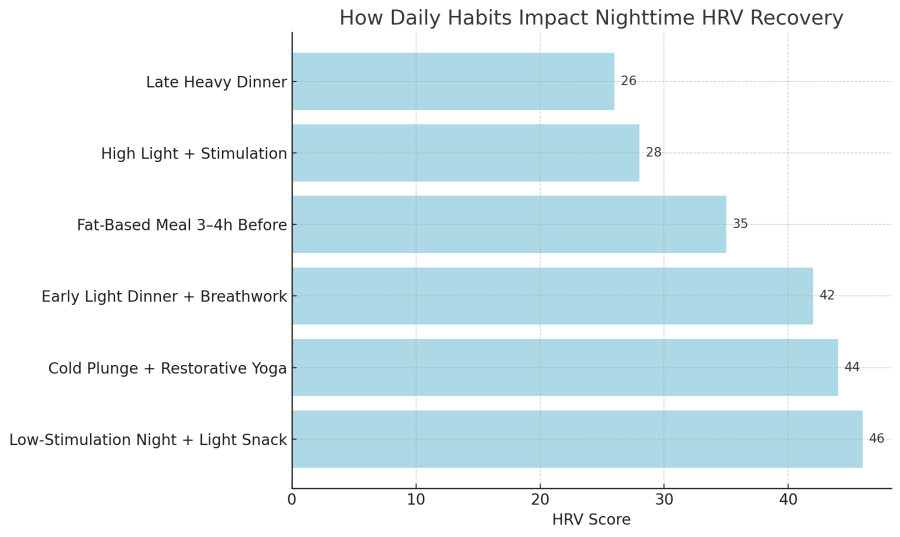
What you eat—and when—matters. I’ve found that meat or fat-based meals must be finished at least 3–4 hours before bedtime. Digesting heavy meals too close to sleep spikes overnight stress and tanks HRV.
But that doesn’t mean I go to bed hungry. Instead, I now use light options that satisfy the ritual without demanding much from my digestive system. These include:
- A small organic apple
- Bone broth
- A spoonful of organic yogurt
- Herbal tea or a light vitamin/electrolyte drink
- Shaved ice or a teaspoon of honey (rarely)
It’s not about hunger—it’s about enjoying a calming moment before sleep, without compromising overnight recovery.
Tracking the Change
HRV (Heart Rate Variability) is my chosen metric to validate these routines. I use a Garmin watch to monitor the impact of different inputs—meals, breathwork, light exposure, and stress—on recovery. When I’ve done it right, I’ll see HRV rise, overnight stress drop, and sleep scores edge into the 90s.
One of my most telling benchmarks came after a night with very low input: I was unwell, ate nothing, and had no stimulation. Despite just 5.5 hours of sleep, my HRV spiked to 46—one of my best readings. That night became a baseline for how little stress the system prefers.
Stuffing Up
When things go off track—whether it’s a late-night meal, stress blowout, poor sleep, or just a cascade of small disruptions—it can feel like all your efforts were wasted. The truth is, the parasympathetic system doesn’t bounce back immediately. Even when you’re doing everything right again—clean meals, breathwork, early dinners, perfect sleep setup—it can take 2 to 3 days for HRV, digestion, and mental clarity to fully reset. This lag time is frustrating but normal. The system recalibrates slowly because recovery isn’t just physical—it’s hormonal, neurological, and emotional. What’s hard is that breaking the system is fast. One wrong late dinner can flatten your sleep and spike cortisol for the entire night. It’s like knocking over a house of cards that took days to build. The key is not to get discouraged. Trust that every “reset” protocol—breath, posture, cold, food timing—is still working under the surface, even if your metrics don’t immediately show it. You’re teaching your body how to come back faster each time. That’s the long game.